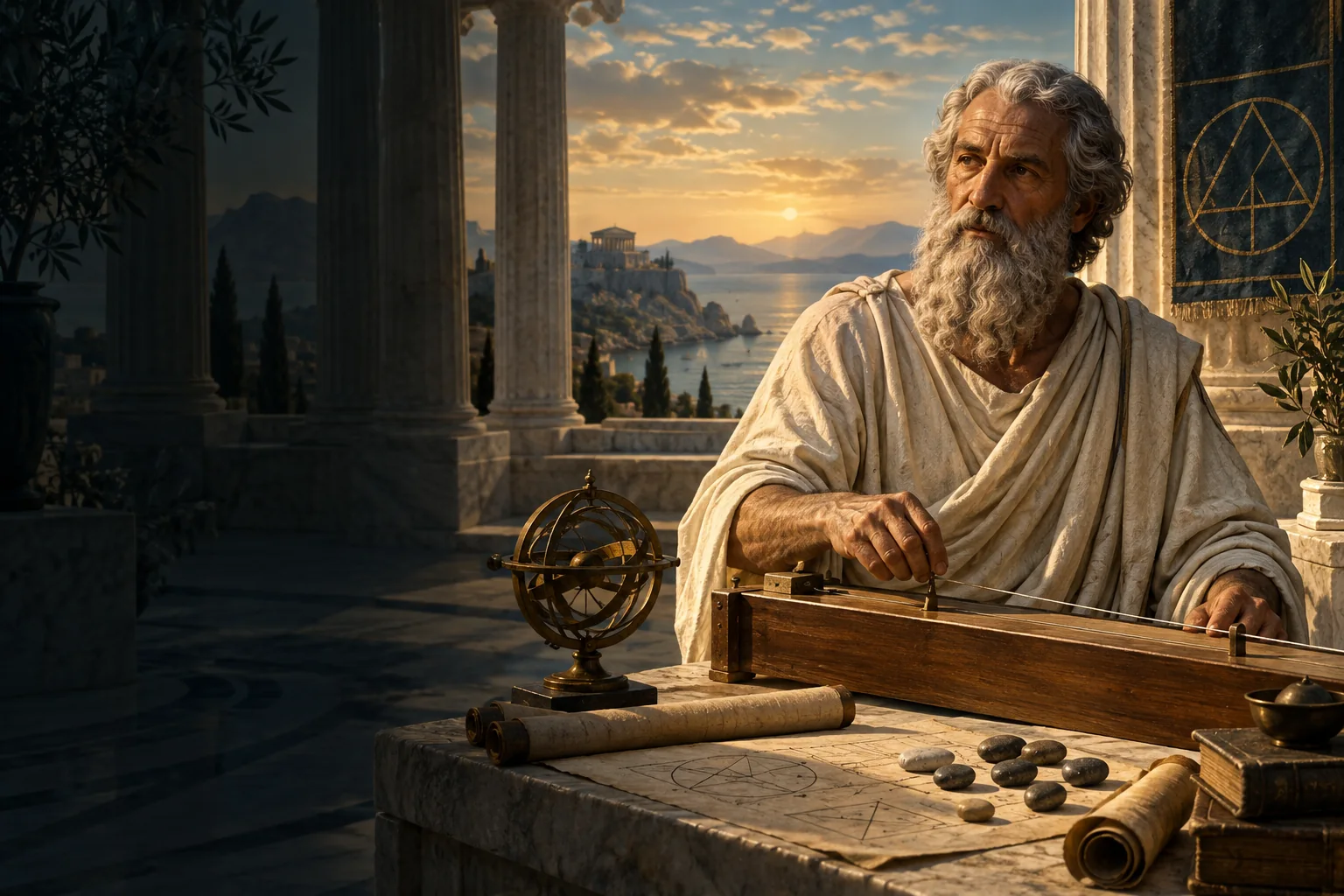
Ancient Greece / A philosophical foundation
Meet Pythagoras.
Number, music and the search for harmony.
Pythagoras lived around 570–490 BCE. The tradition associated with him made number and proportion central to thinking about an ordered world.
Explore this chapter ↓Ancient Greece / A philosophical foundation
A person, a school, a long afterlife.
Pythagoras left no writings. Much of what we know comes from later accounts, and the work of his followers must be distinguished from claims about the man himself. The portrait is an artistic interpretation, not a verified likeness.
Listen to a ratio.
Listen to a ratio.
Musical intervals can be described by numerical ratios. An octave corresponds to a frequency ratio of 2:1. Such relationships help explain why harmony became a powerful image of numerical order.
A calculation is reproducible. Its symbolic meaning is an interpretation.
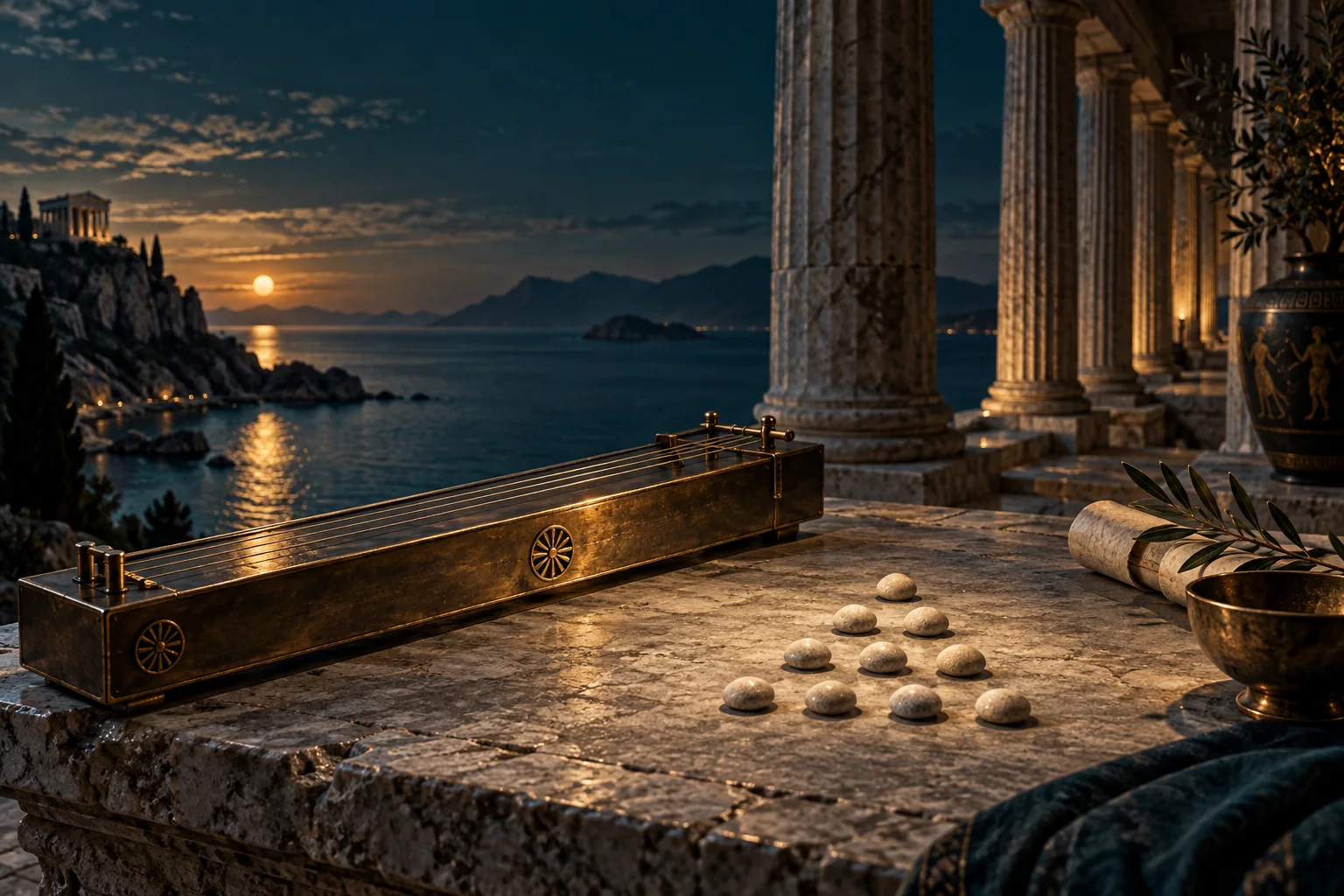
Inspiration is not the same as invention.
Modern numerology draws inspiration from Pythagorean number symbolism. That does not establish that Pythagoras invented today’s alphabet tables or personal name readings. Åse’s practice belongs to the modern interpretive tradition.
Historical source: Stanford Encyclopedia of Philosophy ↗
Since 1997
Your guide
Åse Karin Steinsland
Numerologist and life guide near Bergen. Personal analyses since 1997.
“Calculate the parts. Then read the whole.”
Explore the next chapter
Numerology offers symbolic interpretations for reflection, not scientifically established descriptions of personality or predictions.